
October 13, 2026
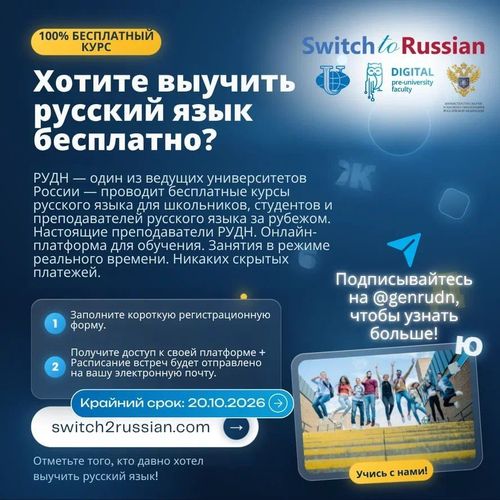
Learn Russian for free from home?
1 min

The 26th World Russian People's Council (WRPC) was held on November 18–19 in Moscow at the Cathedral of Christ the Savior. The plenary session took place on November 19 and was dedicated to the military and spiritual feats of defenders of the Fatherland throughout the ages. Patriarch Kirill delivered the keynote address.
The Council was attended by hierarchs, priests and monastics of the Russian Orthodox Church, representatives of state authorities, members of the Federation Council and deputies of the State Duma of the Federal Assembly of the Russian Federation, members of the Bureau of the Presidium of the WRPC, senior clergy of Russia's traditional religious organizations, and figures from science, education and culture, as well as representatives of the public.
At the Council, participants discussed the status of military clergy, the rehabilitation of soldiers, the preservation of historical memory, as well as migration, demography, neo-paganism, ideology and the general social climate in Russia.
Alexander Shchipkov, rector of the Russian Orthodox University of St. John the Theologian, called in his speech for the revival of the traditional Russian school of psychology, based on the works of the Church Fathers.
“Orthodox psychology in Russia was based on the patristic teaching about the human person and was developed primarily in theological schools… Orthodox psychology is based on the patristic understanding of the human person. It is a scholarly discipline integrating modern psychology, Christian anthropology and the writings of the holy fathers. The principles of Orthodox psychology are theocentrism, the likeness of the human person to God, and the divine image in the human person,” Shchipkov said.
Shchipkov noted that the spread of secularist spiritual care and the penetration of secular psychology into Church thought are a challenge for Orthodox psychologists today. This challenge requires a timely, principled and substantive response, since the situation is becoming quite dangerous.
At the November 18 session “Diplomacy and Law in Defense of Russian Orthodoxy,” Metropolitan Anthony of Volokolamsk, chairman of the Russian Orthodox Church's Department for External Church Relations, recalled the need to defend fellow believers in countries where traditional Orthodoxy is subjected to systematic persecution and even banned.
“Of particular concern is the church schism in Ukraine, provoked by certain political forces, as well as discrimination against Russian Orthodoxy in Moldova and the Baltic states,” Metropolitan Anthony noted.
According to Metropolitan Anthony, what is happening warrants an adequate response and fair assessment from the international community, although such an assessment is unlikely to emerge in Western countries.
Vasily Shchipkov, associate professor at MGIMO University of the Russian Ministry of Foreign Affairs and first vice-rector of the Russian Orthodox University of St. John the Theologian, expressed the conviction that attacks on Moscow Patriarchate parishes abroad are an internal problem of Russian civilization. In his view, the boundaries of the Russian Church are neither political nor geographical; they are defined by a timeless and placeless catholicity (Christian universality). Although church parishes in different countries sometimes visually correspond to state borders, the Moscow Patriarchate is a single spiritual organism. Its parishes in Ukraine, Belarus, the Baltics, Central Asia, Europe, Africa, Southeast Asia and the United States share a common spiritual destiny.
Thus, the territory of the Russian Orthodox Church effectively marks the boundaries of Russian civilization. Therefore, any attacks on Moscow Patriarchate parishes abroad—even if they are legally and financially independent of Moscow—should be viewed as attacks on an institution at the foundation of the Russian civilizational model. On this basis, the defense of Russian Orthodoxy abroad should be seen as an internal task of the Russian Church and the Russian state. This is not an external but a deep-rooted problem connected with preserving the identity and unity of Russian civilization, Shchipkov believes.
In addition, the Council's program included a session devoted to migration issues. Participants discussed the new Concept of Migration Policy of the Russian Federation, adopted on October 15, 2025. It was noted that Russia's main source of migrants should be Russian people from the countries of the former Soviet Union and foreigners who share our traditional spiritual and moral values.
“For all other migrants, an excellent legal regime is provided—that of temporary residence in the Russian Federation for work or study,” Alexander Shchipkov summed up his address at the session.
In his closing remarks, Patriarch Kirill said that one of the most important tasks for both the Russian Orthodox Church and the family and socially oriented public organizations is to raise children and young people “in faith, piety, love for the Fatherland, and fidelity to our traditions, on which this remarkable edifice of historical Russia was built.” Following the session, a Council Address was adopted, aimed at further strengthening the Russian world and Orthodoxy.
Publication date: November 20, 2025
October 13, 2026
October 7, 2026
October 5, 2026
October 5, 2026
October 2, 2026
October 2, 2026
October 1, 2026

September 29, 2026
September 29, 2026
September 29, 2026
September 29, 2026
September 28, 2026
September 27, 2026
September 25, 2026
September 25, 2026
September 24, 2026

September 23, 2026
September 23, 2026
September 21, 2026
September 20, 2026
September 17, 2026
September 17, 2026
September 17, 2026
September 16, 2026

Do you have any questions?