
October 13, 2026
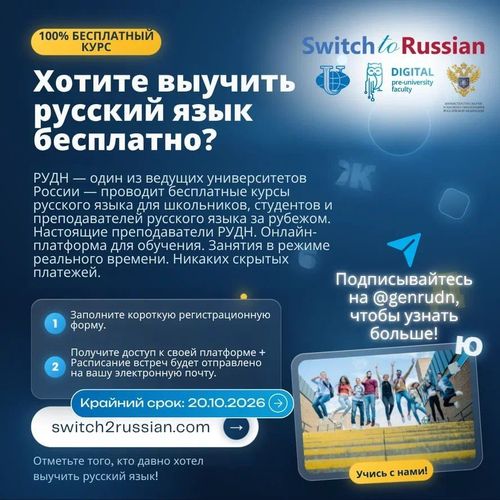
Learn Russian for free from home?
1 min
The State Duma Discussed Issues in Protecting the Russian Language in the Post-Soviet Space

On December 9, the State Duma Committee on Family Protection, Fatherhood, Motherhood and Childhood held a roundtable on protecting the Russian language in the countries of the post-Soviet space. Participants included government representatives, scholars, experts and public figures from Russia, Kazakhstan, Kyrgyzstan and Azerbaijan.
The key topic of discussion was the objective weakening of the Russian language’s position in neighboring countries, which creates serious barriers to prospects for cultural, economic and educational cooperation. The declining number of Russian-language schools and teachers is leading to a “generation gap” in language.
Nina Ostanina, chair of the relevant committee, noted that only 20% of migrant children had successfully passed the Russian-language test for admission to Russian schools. Among the key problems, the deputy cited the exam format and the difficulty of the tasks, which in practice prevent even children who know Russian from entering school. This is akin to deliberate sabotage, Ostanina said, expressing regret that representatives of the agencies responsible for developing these tests were absent from the roundtable.
Ildar Gilmutdinov, first deputy chair of the State Duma Committee on Nationalities, drew attention to the weakening of Russia’s “soft power” abroad due to a shortage of budget funding, compared with other countries’ large-scale investments in promoting their languages and cultures, referring primarily to the organization TURKSOY.
Dauren Abayev, Kazakhstan’s ambassador to Russia, believes that the Russian language’s key mission is to unite peoples. The diplomat called for preserving the Russian language’s unifying role and noted that in Kazakhstan, Russian and the state language are developing without detriment to one another.
Aydai Omurkулова, counselor-minister at the Embassy of Kyrgyzstan, confirmed the official status and active use of the Russian language in the country. It is used at all levels, ensuring the smooth functioning of the state and facilitating interaction with citizens. The diplomats noted that Russian remains a key means of communication between our peoples in business, education and culture.
Yusif Vezirov, an adviser at the Azerbaijani Embassy in Russia, described the situation with the Russian language in the republic as stable. He emphasized that Russian is studied as a first or second language in more than 300 schools in the republic; it is home to the Vurgun Russian Drama Theatre and branches of Russian universities—the M.V. Lomonosov Moscow State University and the Sechenov Medical Institute. Airtime is also allocated for Russian-language programs on AzTV’s first channel; the CBC channel broadcasts 24 hours a day, newspapers and magazines are published, and online media operate.
Vasif Gasanov, president of the Federal Lezgin National-Cultural Autonomy (FLNCA), believes that the Russian language plays a leading role in preserving and developing the cultural heritage of the peoples of Russia. Lyudmila Korsun, a representative of the Moldovan FNC, spoke in her remarks about the challenges of supporting the Russian language.
Participants in the roundtable proposed measures to strengthen language support, develop additional learning programs and promote international cooperation in education. The meeting will result in recommendations for government bodies, educational institutions and public organizations.
Photo: duma.gov.ru
Publication date: December 11, 2025
October 13, 2026
October 7, 2026
October 5, 2026
October 5, 2026
October 2, 2026
October 2, 2026

October 1, 2026

September 29, 2026
September 29, 2026
September 29, 2026
September 29, 2026
September 28, 2026
September 27, 2026

September 25, 2026
September 25, 2026
September 24, 2026

September 23, 2026
September 23, 2026
September 21, 2026
September 20, 2026
September 17, 2026
September 17, 2026
September 17, 2026
September 16, 2026

Do you have any questions?