
October 13, 2026
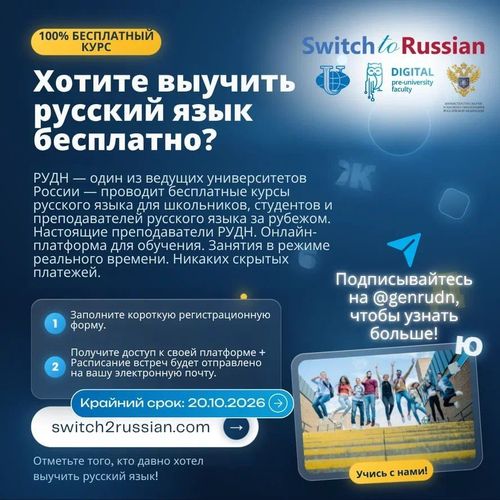
Learn Russian for free from home?
1 min

According to the Ministry of Science and Higher Education, as of November 2025, 415,000 international students from 187 countries are studying in Russia. A decree of the President of the Russian Federation sets the target number of international students by 2030 at 500,000. Today, international students are an extremely important resource for building loyal national elites and making up for the shortage of skilled labor.
With the issuance of Decree No. 883 of 2.12.2025, “On supporting the resettlement to the Russian Federation of foreign citizens and stateless persons who are of interest to the Russian Federation, and on the specific features of their legal status in the Russian Federation,” the contradiction between attracting talented young students to the Russian economy and the need to build a pool of people abroad who can extend Russia’s humanitarian influence has become acute. In addition, one problem hindering educational mobility is the introduction of restrictive measures for migrants without distinguishing between categories.
The number and mobility of international students are indicators of the quality and prestige of universities and educational institutions. International student mobility affects various aspects of global society, including the socioeconomic, political, and cultural environment, science, and technology. To position itself competitively in the global education arena and attract international students, Russia offers a wide range of programs, including in English.
In addition to the future humanitarian influence these students may exert in their countries of origin, the direct benefits of having them in our country can also be calculated. The contribution of international students, so-called educational migrants, to Russia’s economy in 2024 through tuition and accommodation payments and social, everyday, and cultural expenses amounted to an estimated 254 billion rubles, or $3.2 billion. In 2017-18, the total economic contribution of international students amounted to $2.3 billion.
Regulatory challenges
Despite their fundamentally different contributions and reasons for staying, our legislation scarcely distinguishes between labor and educational migrants. The legal relations of both groups with government agencies are governed by the same laws and departmental regulations, which are aimed primarily at combating illegal migration. International students and graduates are not classified as a separate category of foreign citizens, and all restrictions imposed on other categories of foreign citizens, such as labor migrants, also apply to them. The situation is compounded by a shortage of migration-service staff in the regions, differing interpretations of regulations, an abundance of bureaucratic procedures, and the creation of artificial barriers, for example, to international students obtaining a temporary residence permit for study (RVPO).
The RVPO status, introduced two years ago, has not proved to be a breakthrough solution for simplifying international students’ stay and relieving regional migration services of the administrative burden of annual visa extensions. During the two years the Federal Law has been in force, the permit has been obtained by only 25,000 international students, which is about 6% of those enrolled.
What accounts for this low figure? According to the education community, the reasons lie in excessive and duplicative departmental regulation. The procedures required to obtain an RVPO include fingerprinting and a medical examination, which students already undergo when enrolling at a university; repeating them imposes an additional financial burden.
In addition, a key barrier to obtaining an RVPO is the requirement to provide a certificate of no criminal record among the documents specified by an order of the Ministry of Internal Affairs. This seems illogical and excessive for international students and, as practice shows, difficult to fulfill.
By eliminating excessive requirements (repeat procedures, criminal record certificates, and regional restrictions on transfers between universities), simplifying migration-status applications, and automating core processes (registration, support, and interaction with the Ministry of Internal Affairs), the RVPO could genuinely help address the problems universities face. It is also important that, under current conditions, the RVPO is a powerful tool for the competitiveness of Russian education, since this regime will be compared with European and Asian residence permits and the American F1 visa F1. Simplicity, predictability, and security in the migration regime are a global trend that shapes a country’s reputation as open, welcoming, and focused on attracting talent.
The implementation practice of the RVPO status, long awaited by universities and students, is a clear example of the need to rethink regulations governing educational migration. The list of problem areas could go on: issuing visas for additional education programs (DPO), the mechanism for extending student visas, difficulties interacting with the Register of Controlled Persons and regional migration departments of the Ministry of Internal Affairs, undergoing mandatory medical examinations followed by paid registration in the Ministry’s database, and the state fee for registering at one’s place of stay.
Universities’ ability to change the situation remains limited. The political and administrative weight of the government agencies that regulate these matters far exceeds the influence of representatives of science and education.
Approved by presidential decree on October 15, 2025, Russia’s Migration Policy Concept is predominantly restrictive in nature, but it also identifies the following priority areas:
In search of a solution
How can the existing contradiction between the general tightening of the migration regime and the strategic goal of attracting talented young people be resolved? There is an urgent need to create a more effective instrument for interagency cooperation, such as a public office of an ombudsperson for the rights of international students or a standing working group at the level of the Russian Government, as well as to conduct expert assessments of adopted departmental regulations in terms of their legal consequences. Such coordination would reduce the administrative burden both on government agencies and on the students themselves, who encounter a high level of bureaucracy as soon as they arrive in the unfamiliar environment of a foreign country.
The need for coordinated work by government agencies is a theme running through most national strategies in other countries. Proposed measures include creating a special position of an appointed official responsible for promoting national education worldwide, along the lines of the British International Education Champion; establishing official interagency coordinating bodies (for example, similar to Canada’s national public Council, and Ireland’s Forum for implementing the strategy (Implementation Forum); and organizing and holding periodic meetings and workshops with representatives of all stakeholders to build cooperation on the most pressing issues of interagency coordination.
The category of “educational migrants” needs to be enshrined in regulations as a subject of migration-related legal relations. Universities that undertake to monitor their international students continuously and support their sociocultural adaptation should be given a simplified procedure for interacting with migration services, while students should see a significant reduction in “transaction costs” at every stage of admission and study.
Author: Alla Shelyapina (https://vezdenashi.ru/)
Publication date: December 27, 2025
October 13, 2026
October 7, 2026
October 5, 2026
October 5, 2026
October 2, 2026
October 2, 2026

October 1, 2026

September 29, 2026
September 29, 2026
September 29, 2026

September 29, 2026
September 28, 2026
September 27, 2026

September 25, 2026
September 25, 2026

September 24, 2026

September 23, 2026
September 23, 2026

September 21, 2026

September 20, 2026

September 17, 2026
September 17, 2026

September 17, 2026
September 16, 2026

Do you have any questions?