
October 13, 2026
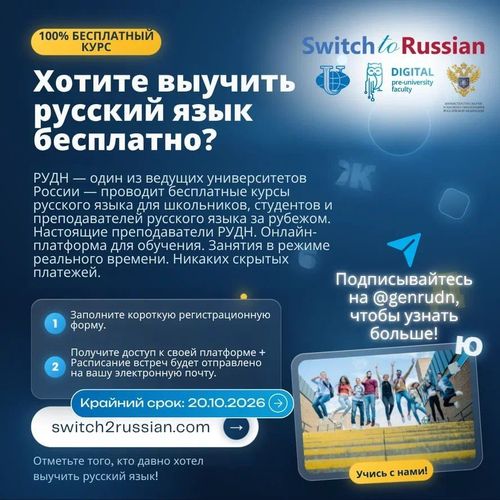
Learn Russian for free from home?
1 min
I Want to Live in Russia! Every Emigrant Has Their Own Story, but There Is Only One “Path Home”

Stavropol has become one of the centers attracting people who are returning to Russia after many years of living in the West. It is also home to the office of the public organization “Path Home,” which helps compatriots return to their homeland and helps foreigners decide that they will be better off in Russia than anywhere else.
Anatoly Bublik gave an extensive interview to the popular news portal Ukraina.ru. The full version is below.
Anatoly Bublik moved with his family from Germany to Stavropol on August 2, 2022, and in October the first newcomers followed: two or three families came each month to have a look, then began settling down. There are now more than 30 such families in Stavropol.
“We had never seen Stavropol before moving,” Anatoly explains why they chose this particular city. “But it turned out that my wife had a former classmate living here. She sent us photos, and in the end the deciding factor was the opinion of someone you hadn’t seen in more than 20 years.”
Previously, Rostov, Krasnodar, and Belgorod were centers attracting newcomers because they are close to the border, and it was relatively quick and easy to travel from there to Europe to visit relatives. Everything has changed now. People still want to live in the south, but farther away from places that could potentially be reached by a drone or entered by an enemy sabotage and reconnaissance group. Stavropol is an ideal solution in this respect. It is green and warm, ethnically diverse, with jobs and relatively inexpensive housing; all the food is locally produced; polluting industry is 50 km from the city, in Nevinnomyssk; the mountains are nearby and the sea is five hours away by car. This combination of factors, along with the fact that Anatoly Bublik’s organization, “Path Home,” can meet arrivals and provide the necessary help, proves decisive.
“When you’re a newcomer yourself and people see your success story, everyone wants to know how you did it,” Anatoly says. “So when we started talking about ourselves, it turned out that thousands of people were interested.”

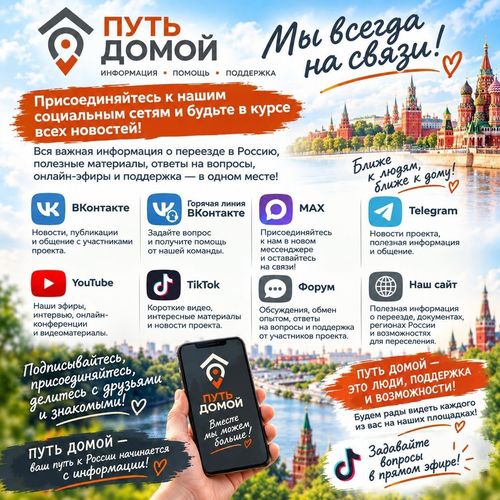
At some point, it became clear that help was needed to communicate with people. That was how the core team of administrators for the “Path Home” project came together; they answer people’s questions about relocation online. So many inquiries came in that several different areas of work had to be set up: hosting online streams about moving to Russia, working with technology, and working with documents—they need to be up to date and uploaded to the project’s webpages so people can use them. Gradually, the media became interested in the organization, so a separate public relations employee was needed. A Telegram hotline was launched, and people can ask “Path Home” staff questions on any social network, even ones blocked in the Russian Federation; through them, people can get answers from lawyers, universities, a consul, and representatives of the Ministry of Internal Affairs. The “Path Home” project now has an office in Stavropol and more than 50 staff members working across 36 platforms and processing thousands of applications from people who would like to relocate to Russia. Anatoly Bublik is a member of the interdepartmental working group on relocation issues at the State Duma of the Russian Federation.
More than 152 thousand of our compatriots and more than 4,5 thousand foreigners from 37 countries who would like to live in Russia have contacted the “Path Home” organization. So now we can describe the average person relocating.
They are a family-oriented person aged 30 to 50, bringing at least two children, or even more. In every family, one or both parents have a vocational technical education. More than 40% have higher education, and 1,5% have two higher degrees or an academic degree. For 90% of those moving, Russian is either their native language or a language they speak fluently—they are the children of people who left Russia in the 90s. They can speak and read, but have difficulties with spelling, so they will need further instruction. On average, each family brings enough money to last six months to a year.
Germany is undoubtedly in first place in terms of the number of people wishing to move to Russia: 38% of those who contacted us are from there. Our consular offices say that 3 million Russians live there, but German statistics put the figure at 6–9 million—although these are Russian speakers from all the republics of the former USSR. Almost all those coming from Germany are educated—most have vocational technical education, while those with higher education are primarily teachers and doctors.
Kazakhstan is the second country. Officially, it has more than 3 million people, and unofficially probably more than 4. Almost 20% of our inquiries come from Kazakhstan. Most often, they are men working in technical fields and women who are teachers.
10% are from the Baltic states, another 10% from the rest of Western Europe, excluding Germany; 5% are from Asian countries other than Kazakhstan, and 2% each from Israel, Canada, the USA, and Eastern Europe. There are even two families from Nicaragua and one from South Africa. 5% of inquiries are from Ukraine.
Foreigners who want to move to Russia—expats—are either specialists with higher education or entrepreneurs with financial reserves. They want to move to a new country in search of opportunities. Americans and Canadians are almost all traditionalist farmers. They are used to working and living within their families as they choose. They are now being deprived of their customary way of life, and they are looking for a way out in Russia. Russian regions are eager to welcome such farmers because they bring prestige, investment, and even technology.

— And do these farmers establish ethnic settlements?
— I travel all over Russia myself, talking with regional authorities and heads of administrations. And, of course, not everyone, but many want ethnic settlements; they want to get the benefits of relocating foreigners, as happened under Catherine II—clean villages, hardworking citizens, and so on. But they don’t think about the fact that they will get a diaspora. I spoke with ordinary people in the German national district in Omsk Oblast and came away with mixed impressions. On the one hand, they say, “We’d like more families with children who share our values to come here.” But when you get down to specifics and say you’ll bring 50 families and they’ll build themselves a little village, people turn against it: “We don’t need that. There are 10 empty houses in our settlement—let them move into those.” They are ready to help newcomers, but don’t want any closed communities in their country. Politicians and administrators don’t always understand this.
We also often assume that newcomers need to be provided with some high standard of living, that Europeans, Canadians, and Americans expect the same things here that they had there. We know of large families from Canada, America, and England who came here and live in rural houses that I might have refused to live in. But they live without gas, heat the house with a stove, draw water from a well, and are happy because they got what they wanted. These are most often Christian families who want to have children without being told they are crazy or antisocial, or that they are harming the environment. The latest trend in Europe is that having children is bad for the environment. In Germany, public service ads urge people to save the world by becoming childless. In short, these people expect help with getting their documents processed quickly and starting work or opening a business; they don’t need any special conditions.
— Traditionalist farmers are all very well, but what about progressive people with modern professions and worldviews?
— Designers with higher education, for example, moved to Stavropol. They owned a popular, in-demand 3D content creation company in Germany. Now they create 3D animation in Russia and sell it around the world. Many engineers and technicians are moving to Nizhny Novgorod, because a lot of our high-tech cluster production is based there; to Omsk, because the entire defense industry is there; and to Moscow Oblast. In Russia, especially in Moscow Oblast, they can often be offered higher salaries than they received in Europe. But for people of this caliber, people who create things, money is not always the key issue. The opportunity for self-fulfillment matters too, as does the ability to introduce innovations and develop ideas. There’s a huge amount of untapped potential here. And this isn’t just about drones or rockets: engineers and technicians are in high demand in automotive manufacturing, shipbuilding, and hydroponics. We received an inquiry from the Netherlands from a family in which both the husband and wife are hydroponics specialists. It turned out there were so many vacancies for them in Russia that they are choosing between three cities. A German who develops algorithms for stages that detach during a rocket’s launch also got in touch. He wants to move to Russia because he feels he can put his knowledge and skills to use here.
The “Path Home” organization’s office is a real headquarters, coordinating activities across all areas and developing strategy.
“People first come to scout things out, to look at several regions. That’s why they come to us: to figure out how to integrate faster and how to settle their children in,” says Maria, the head of the headquarters. “Now, with repatriation, many have started thinking about their roots, wondering whether they have a great-grandfather who was born in the territory of the Russian Federation, because that makes the relocation and citizenship process simpler. So demand for Russian ancestry is growing. But when they first contact us online, they generally have no idea where to start, so we have to drag the information out of them with pincers: who are they, how old are they, what citizenship do they hold, have they ever been to Russia, did they leave after February 24, 2022? There are many families where one spouse wants to move to Russia and the other is absolutely terrified. And they plead with us, for Christ’s sake, to help persuade them.”
In addition, the “Path Home” organization has regional chats where people who have already gathered all the necessary documents, while awaiting a decision from government agencies, collect belongings, arrange containers, load vehicles, look for housing in Russia, kindergartens, and so on. “Path Home” administrators help them with all of this.
“Then life in Russia already feels somewhat familiar, even from a distance,” Maria explains.
According to her, before making a final decision to relocate, people want to understand what awaits them in Russia, taking into account the social benefits available in a number of countries far abroad. They have to be told that it will be ordinary life, like everyone else’s in Russia—you’ll have to work and live within your means. Many are disappointed that, having arrived in Russia with children, they can no longer use maternity capital to pay their mortgage; to do that, they have to have children here. There are many different practical and economic factors that mean those who decide to move do not always come out ahead.
Maria finds these objections painful, although at first glance they seem objective. Recalling her own experience of living in Germany, she says it was quite comfortable there, especially since you don’t become too detached from Russian culture: you’re at home with relatives and friends, speak Russian, and attend Russian celebrations. People have no borders, and in that sense you can find a purpose and be useful in completely different places. But the special military operation in Ukraine changed a lot.
“As soon as you have to choose between right and wrong, black and white, all the tolerance just disappears, and you realize that everything here is alien to you. As it turns out, it is there, in these circumstances, that you learn patriotism in its proper sense, in a non-vulgar sense. You realize that you have to defend the interests of the Russian language and Russian culture, that you must not be afraid or ashamed to call yourself Russian. And not to give your children foreign names or change your surnames. This comes when everything is at stake and you have to decide: there or here. If your desire for convenience and comfort, which requires you to look like you belong abroad, wins out, you condemn yourself to eternal longing that sits deep in your soul. You pretend, you play the respectable citizen, but in essence you are lonely and misunderstood. It’s a real tragedy. You can go mad like that.”

The “Path Home” headquarters has organized various activities for those hesitating because they fear their financial situation will worsen (although, as Anatoly Bublik rightly noted, many skilled professionals actually improve theirs): learning Russian, immersing themselves in Russian history and poetry, and learning about monuments or art installations in the regions where people are relocating.
“We want to touch the hearts of those relocating, to show that Russia is more than just a territory. And those who come here to scout things out see respect for elders, support for young people, cultural events, and philharmonic societies and theaters even in the smallest provincial town—the impression you get in person is completely different from what you get online from afar.”
People relocating from Ukraine most often do not need the services of the “Path Home” office, because the process for them to obtain citizenship is fairly simple. But there are special situations, primarily related to the problem at Sheremetyevo Airport.
For example, there is a family in Stavropol from Odesa who moved last summer. The father is a sailor who works on contracts. The family applied for a residence permit, but the man was called away on a six-month voyage before the document was issued. He got permission from the migration inspector, obtained all the necessary receipts, and left. His voyage ended, but he cannot enter Russia.
“At first he tried to get to Sheremetyevo via Turkey on the eve of the presidential election. They turned him back, saying this wasn’t the right time and to come back in a couple of weeks. A couple of weeks later, the ‘Crocus’ attack happened, and they turned him back again without even screening him. So now he’s in Istanbul, while his wife and child have already obtained Russian citizenship.”
Migration lawyers are now handling the matter, because it is obvious that the man simply arrived at the “wrong time” twice, and that is the only reason he was denied entry. However, there is no written refusal; it has all been verbal.
This is a subjective factor, but Maria says there is also an objective factor making it difficult for people to come to Russia.
“When the relevant laws were being written in the late 90s, their ultimate goal was not to make relocation peaceful and problem-free. They were more prohibitive in nature. So our admins often send inquiries to the Ministry of Internal Affairs, the Federal Customs Service, and the border service to get clarification on specific provisions of the laws for particular situations. Once they have instructions, it is much easier for newcomers to arrive.”
“They think we have wooden outhouses, but they come anyway”
Olga is the executive secretary of the “Path Home” organization.
— You are Russian and didn’t move here from somewhere else, but you’ve nevertheless embraced the idea of helping compatriots return to their homeland. Why did you decide this was important to you?
— I’m Russian, and what’s more, a native of Stavropol. When Anatoly and Maria told me that people were moving here from Europe, I was very surprised, because we’re used to thinking that things are better over there than here. Now all the incoming inquiries to our email and all the phone calls come through me.
— Are the people who contact you from abroad different in any way from those around them? Although they are compatriots, they have lived in another culture for a long time.
— When I first started talking with potential newcomers, it seemed strange to me that we were speaking Russian, the same language, but somehow differently, with different sentence structures. It took me about 4 months just to be able to speak with them on the same wavelength and understand them. And, of course, many are panicking because they want to move and don’t know where to begin. That’s understandable: you have to gather a huge package of documents and figure out exactly where to go. Many think Russia has wooden toilets or something like that.
— Really? And they want to move despite the wooden toilets?
— Yes, they think we have no civilization at all, but apparently they’ve had enough of everything over there, so that doesn’t become an obstacle. Then, when they arrive, their amazement knows no bounds: “Wait, you can transfer money by phone here!” Even though you can’t do that in Germany. They have cards that you have to connect to a laptop to transfer money, and it may take two or three days to arrive.

— And what do people usually ask about, besides wooden toilets?
— The most common question is how to move cheaply. Those questions are very vague, of course. For us administrators and volunteers to provide any information, we need some basic details: where the person is writing or calling from, what citizenship they currently hold, what year they or their relatives were born, because this determines how they can move to Russia, under which program, as a repatriate or a compatriot, or perhaps obtain a residence permit and then citizenship under a simplified process. They ask how much real estate costs, whether to buy or rent, how to enroll a child in school, how much food costs, which city is best to move to, where to work, and what the salaries are. For people relocating from Germany, for example, the salary levels are a shock, because for work that pays 100–150 thousand rubles in Russia, they earn the equivalent of 200–300 thousand rubles there. But they don’t immediately understand that taxes are lower here and prices are lower. It takes time to adjust.
— Do you meet people who don’t know Russian? Perhaps children born abroad?
— I haven’t met children who don’t speak Russian at all. They always have at least some basic knowledge. They are either advised to stay in homeschooling or are placed one or even two grades lower at school, because their Russian may be behind and other subjects abroad can lag a little too. They study at school for 13 years there, while here we have something like an accelerated program, “for prodigies.”
“Our project exists only because people have problems. If they didn’t have these problems, they wouldn’t contact us,” says Anatoly Bublik.
According to him, the financial well-being of the average person in the West, which everyone had grown accustomed to, has been severely shaken recently. Businesses are closing in Europe because of anti-Russian sanctions, people are losing their jobs, and so they decide to relocate for economic reasons. But there are also others who face blatant violations of their ideas about how one should live.
“A little less than a year ago, a woman had to urgently gather her children and a backpack with documents so she could fly from Germany via Turkey to us in Stavropol. There was just one reason: her child was more active and cheerful than the other children at school. The teacher disliked what she considered to be hyperactivity and filed a report with the juvenile authorities, saying there was something wrong with the girl. The juvenile authorities then made her go to a doctor and take tranquilizers. The mother refused. Then she was told they would come for the child the next day and take her away. That was it—she grabbed the children, bought a ticket, and flew out.”
Stories like these turn Anatoly’s and his organization’s work into a kind of mission. He explains that he cannot send a Russian official to live in the West so they can understand why it is so important to bring compatriots out of there, but he lived there himself and saw how the West was preparing for war.
“We lived in Germany not far from an American military base. They had been preparing for years, both technically and informationally, preparing the population for what was going to happen. We can’t abandon our project, because otherwise people are finished. In the eyes of Western leaders, our people don’t deserve to live. As a project, of course, we can’t defeat the West, but we can save our people from there and help Russia in doing so. Russia urgently needs an economically active population capable of developing our technologies and industry. The more people like this we bring back, the worse things will go for the West and the smaller its mobilization reserve will be. We simply have to do this because, for now, no one else is doing it.”
Anatoly states that both the Russian state and Russian society agree that newcomers should be welcomed. However, several more years of administrative and legislative work lie ahead to organize everything properly. It is impossible to relocate millions of people in such a short time, he believes, but developing a process and regulations is entirely feasible.
Authors: Pavel Volkov, Valeria Yemelyanova—contributors to the publication Ukraina.ru.
The original article can be read here.
Publication date: November 20, 2024
October 13, 2026
October 7, 2026
October 5, 2026
October 5, 2026
October 2, 2026
October 2, 2026
October 1, 2026

September 29, 2026
September 29, 2026
September 29, 2026
September 29, 2026
September 28, 2026
September 27, 2026
September 25, 2026
September 25, 2026
September 24, 2026

September 23, 2026
September 23, 2026
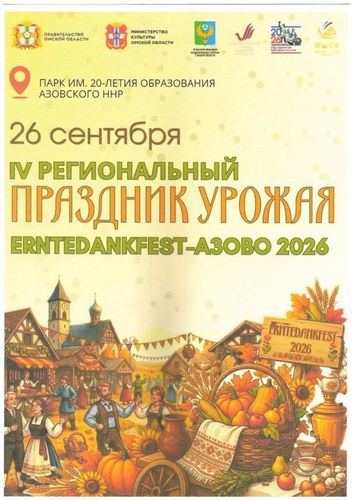
September 21, 2026
September 20, 2026
September 17, 2026
September 17, 2026
September 17, 2026
September 16, 2026

Do you have any questions?