
October 13, 2026
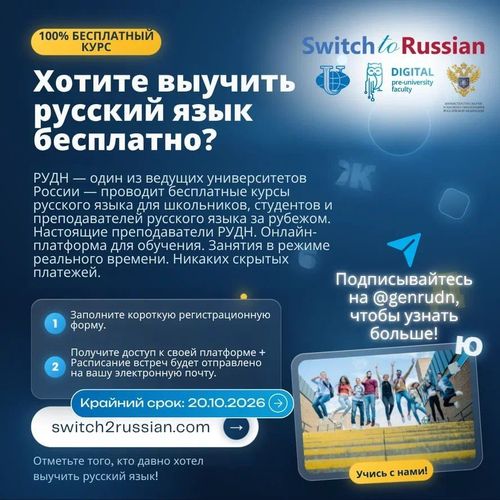
Learn Russian for free from home?
1 min

From 1 July 2026 to 31 December 2027, an experiment is being conducted to implement the possibility of registering citizens of the Russian Federation in the individual (personalized) record-keeping system, obtaining qualified certificates of electronic signature verification keys by Russian citizens outside the Russian Federation, and providing them with state and other services.
Russian citizens who are outside the Russian Federation will be able to complete the full registration procedure in the personalized record-keeping system remotely. This will allow them not only to obtain a legally significant electronic signature, but also to use it for full access to the “Gosuslugi” portal and other state information systems.
The experiment is being conducted in the territories of:
- Armenia
- Vietnam
- India
- Indonesia
- Kazakhstan
- Kyrgyzstan
- China
- Malaysia
- United Arab Emirates
- Serbia
- Türkiye
- Uzbekistan.
Personal attendance is required to obtain an electronic signature abroad. After submitting an application, you will receive a device containing the key and electronic signature certificate.
An electronic signature abroad opens up new opportunities for Russian citizens, allowing them to conduct business, sign official documents, and interact with government authorities remotely, including applying for state and other services using the Unified Portal of Public Services. Electronic signatures for citizens of the Russian Federation who are abroad are issued according to the same principles as in Russia.
The service for Russian citizens to obtain an electronic signature abroad is being implemented as part of the “Rodina Card” project for compatriots.
Note:
How a qualified signature differs from an unqualified one
Three types of signatures are used in Russia to sign electronic documents (carry out transactions): simple, unqualified, and qualified.
A simple signature can be created by the user independently and is used in banking applications, on websites, and in online stores.
An unqualified signature is an encrypted set of characters. If the counterparties recognize its use, it has legal significance. In this case, the signature is suitable for signing delivery notes, contracts, personnel documents, and agreements.
A qualified signature is also created using cryptography, but the requirements for it are established by the state, and it has legal force without additional agreements. An individual can obtain it only from a certification center accredited by the Ministry of Digital Development. It is used to sign any documents in electronic format, submit reports, and formalize transactions.
Publication date: June 22, 2026
October 13, 2026

October 7, 2026
October 5, 2026

October 5, 2026

October 2, 2026
October 2, 2026

October 1, 2026

September 29, 2026

September 29, 2026
September 29, 2026

September 29, 2026

September 28, 2026

September 27, 2026

September 25, 2026
September 25, 2026
September 24, 2026

September 23, 2026

September 23, 2026

September 21, 2026

September 20, 2026

September 17, 2026
September 17, 2026

September 17, 2026
September 16, 2026

Do you have any questions?