
October 13, 2026
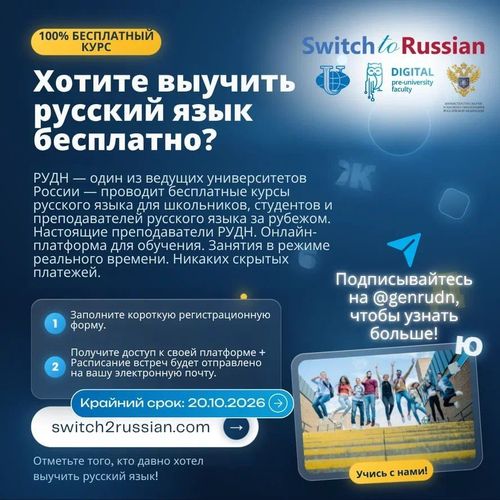
Learn Russian for free from home?
1 min
In the genetic memory of each of us lives a remarkable trait that an outsider might call skepticism, while we have come to regard it as folk wisdom. We are talking about our habit of listening to the official voice and instinctively looking for hidden meanings, reading between the lines, splitting what is said in two. For centuries, we have grown used to the fact that the truth does not always come from loudspeakers; it is born in the quiet of kitchens, in unhurried conversations on the stairwell over a cigarette, or in a brief call to an old colleague.
This distrust of the "written word" is not a weakness. Would you agree that it is our defense mechanism, our cultural immunity? And yet behind this skepticism lies something much deeper and brighter—a colossal, almost mystical faith in one of our own.
"And may God preserve you! Do not read Soviet newspapers before lunch... Patients who do not read newspapers feel perfectly well." Mikhail Bulgakov, "The Heart of a Dog"
When official reports seem cold and, as we would say today, clickbaity, we turn to those close to us. Why does the opinion of someone close to us, who knows nothing about the subject and is not a professional in the field, seem more precious than gold? Because behind it is not a dry set of regulations, but a living perspective, a considered judgment, and personal responsibility. Our true unifying code lies in this act of passing news "from heart to heart." We trust not publications or headlines, but living people. This is the very "thought of the people" that Leo Tolstoy wrote about, finding truth not in grand halls, but in the simple and sincere words of Platon Karataev, who becomes the spiritual center of the work.
This faith is our invisible bond, our fortress. While the world builds complex systems of control, we build anti-options (think of anti-vaxxers, for example) and connections based on a simple "someone I know told me." And this is where our incredible resilience lies. We are a people of solidarity, where each of us is a link in an endless chain of mutual aid that has saved us in times of turmoil, in the icy dugouts of great wars, during the pandemic, and so on.
Today, this trait of the Russian people is gaining new strength. In an age of information noise, our ability to filter out what comes from outsiders and hear the voices of "our own" becomes a lifeline. We may argue with screens, but we will always find words of comfort for the person beside us.
"Let's join hands, friends, so we won't perish alone."
Bulat Okudzhava
Our "word-of-mouth" is not just rumors. It is the call of the blood, an acknowledgment that our neighbor's fate is closer to us than any distant project or election victory. It is a call to stick together with our own. We are the children of those who survived where empires collapsed and textbooks were rewritten. Our character was forged not in the quiet of libraries, but amid the smoking ruins of great and tragic events, each of which taught us one thing: when the ground gives way beneath your feet, the only stronghold left is the shoulder of a fellow soldier, a neighbor, a friend, a colleague...
To be Russian today means carrying this bitter and proud experience within you. It is the right to call yourself a people who have learned to fall silent together when in pain, to joke when afraid, and to hold on when all seems hopeless. We are not just a club of people with shared interests; we are the living descendants of those who endured. We question the letter because we are used to seeking the Spirit. And as long as we can hear one another through any noise, as long as trust in "our own" remains our highest law, we remain ourselves, we remain together.
Hold on to that kitchen-table whisper! Stick with your own! In this unity, born of hardship, lies our invincible, quiet truth.
HOTLINE
Publication date: April 9, 2026
October 13, 2026
October 7, 2026
October 5, 2026
October 5, 2026
October 2, 2026
October 2, 2026
October 1, 2026
September 29, 2026
September 29, 2026
September 29, 2026
September 29, 2026
September 28, 2026
September 27, 2026
September 25, 2026
September 25, 2026
September 24, 2026
September 23, 2026
September 23, 2026
September 21, 2026
September 20, 2026
September 17, 2026
September 17, 2026
September 17, 2026
September 16, 2026

Do you have any questions?