
October 13, 2026
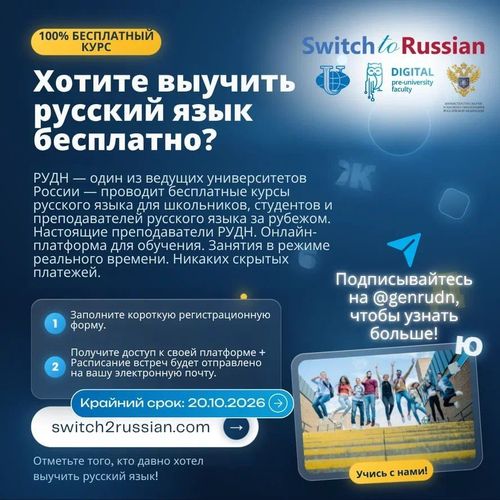
Learn Russian for free from home?
1 min
Time to Live in Russia: Pskov Region Becomes a Model for Integrating Values-Driven Relocators

For the first time in many years, Russia is not merely opening its doors to compatriots, but making a deliberate choice based on shared values. Our country is becoming Noah’s Ark for thousands of people seeking to preserve traditional spiritual and moral principles amid the encroaching new liberal normality. And the “Way Home” project, which over its two years of existence has provided consultations to more than 155 thousand users and helped 2,5 thousand families move to Russia, sees how important it is not merely to welcome a person, but to help them truly find a new homeland.
The Pskov Region, one of the first to introduce a regional standard for social, cultural, and economic integration, clearly demonstrates how this approach works across an entire region and turns it into an attractive destination for relocators.
The success of the Pskov Region in working with relocators is the result of systematic efforts based on a key innovation:
The creation of a unique office of the Governor’s Commissioner for Compatriots and Migration. In July 2024, the region established the position of Commissioner for Compatriots and Migration. This step, noted by Rossotrudnichestvo head Yevgeny Primakov, made it possible for the first time in the country to build a centralized and accountable system for working with new residents. It helped shift from passively receiving applications to active, targeted work together with the “Compatriot” center as a one-stop shop, through which a unique package of support measures is delivered, providing relocators with turnkey assistance. This model, which has become an example for other federal subjects, enables people to receive a full range of services—from legal assistance to enrolling children in school and finding work.
These efforts received high praise at the federal level. As Alexander Vaino, Director of the “Young Professionals” division of the Agency for Strategic Initiatives, noted, the Pskov Region ranked among the leaders, alongside Moscow, the Moscow Region, and the Lipetsk Region, in implementing the integration standard.
The figures cited by Pskov Region Governor Mikhail Vedernikov at the “Time to Live in Russia” conference speak for themselves: around 6 thousand people registered for migration purposes in the region, of whom more than 2,2 thousand have already moved there permanently. For a region with a population of 575 thousand, these are impressive figures, and local authorities quickly responded to the increased influx of relocators.
But behind the figures are people. Statistics from the “Way Home” project confirm that values-driven migrants are coming to Russia—economically active and promising citizens. The typical relocator is an adult with a family, aged 35 to 50, with two or more children. This year, the geography of relocation to the Pskov Region has expanded: alongside traditional countries such as Germany, Moldova, and Estonia, people are coming from Switzerland, Norway, and even South Africa.
The trend toward an increase in the number of large families is particularly notable. A family from Croatia with seven children has moved to the Pskov Region, as have several families from Germany and France with four or five children. A family from Germany with ten children is already preparing to move. These families are not merely a demographic resource, but bearers of traditional family values that are so important to Russia today.
The key to successful integration is creating a comfortable environment from the very first day on Russian soil. Governor Mikhail Vedernikov noted that the region has moved to active measures, involving volunteer organizations and social institutions in this work.
Volunteer teams are formed from among the relocators themselves, helping newcomers adapt and thereby creating a stable, close-knit community.
The Governor also expressed special gratitude to the Pskov Metropolis, which organized individual educational programs for children from Europe, helping them smoothly adapt to their new educational and cultural environment.
Well-established interagency cooperation helps minimize bureaucratic obstacles—one of the main problems that, according to surveys, prevents compatriots from returning to their homeland.
The all-Russian “Time to Live in Russia” conference, held for the first time in Pskov, brought together around 60 participants—representatives of the Federation Council, regional governments, the Ministry of Internal Affairs, the Federal Agency for the Commonwealth of Independent States Affairs, Compatriots Living Abroad, and International Humanitarian Cooperation (Rossotrudnichestvo), the Agency for Strategic Initiatives, and legal and public organizations. It did more than sum up the results; it charted concrete paths for development.
Initiatives were presented to establish a Russian-language learning center and a volunteer team made up of relocators themselves. These projects aim to strengthen cultural and social ties.
It is important to note that since 1 July 2024, compatriots around the world have had a powerful digital tool for staying connected with their Homeland—the “Rodina” electronic card. This service, developed with the participation of Rossotrudnichestvo, makes it possible to access Russian government services remotely, as well as verified information and job databases. The “Rodina” card will be an important resource both for those planning to move and for those already settling in Russia.
As Rossotrudnichestvo head Yevgeny Primakov rightly noted,
“We must help people feel at home. This requires deep human involvement.” The experience of the Pskov Region is a success story based on a systematic approach, deep human involvement, and the belief that Russia is not merely a territory, but a common home that we are building together for ourselves and our children.
Publication date: November 27, 2025
October 13, 2026
October 7, 2026
October 5, 2026
October 5, 2026
October 2, 2026
October 2, 2026
October 1, 2026

September 29, 2026
September 29, 2026
September 29, 2026
September 29, 2026
September 28, 2026
September 27, 2026
September 25, 2026
September 25, 2026
September 24, 2026

September 23, 2026
September 23, 2026
September 21, 2026
September 20, 2026
September 17, 2026
September 17, 2026
September 17, 2026
September 16, 2026

Do you have any questions?