


October 13, 2026
Learn Russian for free from home?
1 min
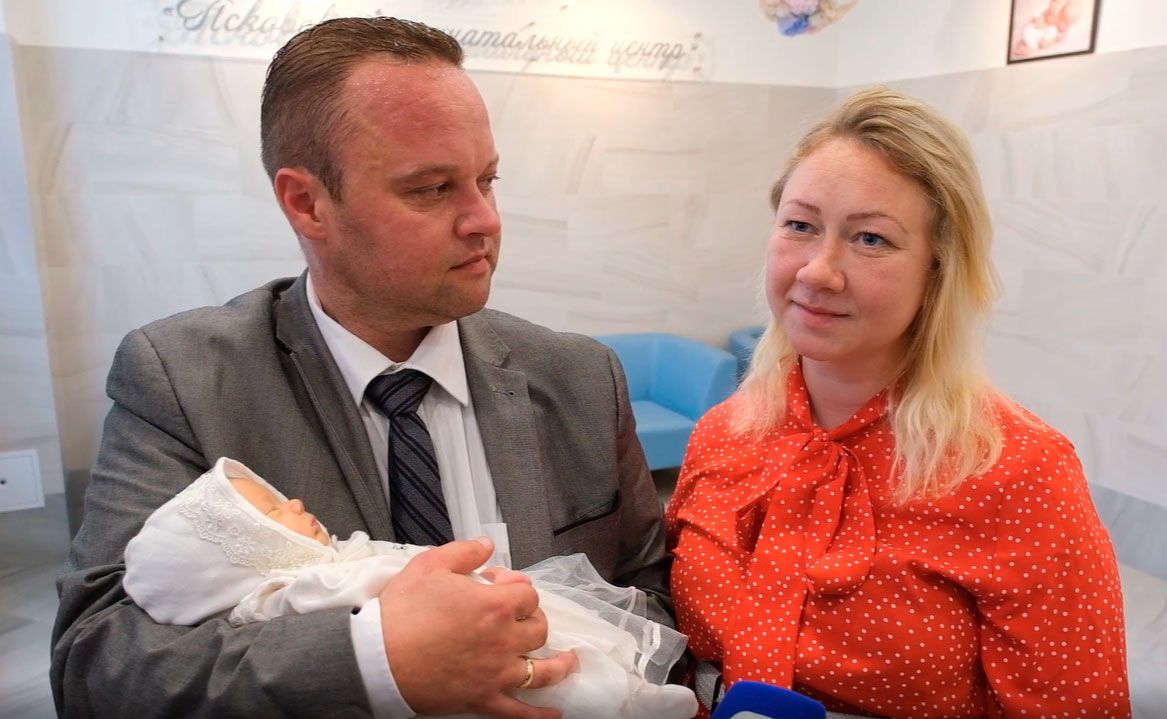
Today, Igor Ulitin and Angelika Lukaszewska, who fled Ireland, are celebrating a new addition to their family. The couple have had a daughter; on July 11, the mother and baby were discharged from the Pskov Perinatal Center, a PAI correspondent reports.
The girl was named Katya. For the family, she symbolizes a new stage in life after a long and difficult journey from Ireland through eight countries, which took 2.5 weeks. “A new future begins for us here, with a clean slate,” Igor said.
He noted that there were various reasons for moving. One was that the UK authorities took his and his wife's children away from them—both their children together and his wife's children from her first marriage. According to him, the children were taken away under various pretexts and placed with other families.
“Our children are being traded, handed over to other families. Because we are not from their country, we were not born there. We had very little support there; there was no way even to fight,” Ulitin shared.
In the end, the family decided to leave for somewhere they would be treated differently. “In Ireland, they knew we were going to have a third child. Our names were flagged at airports so that we would be stopped. We had to get into the car, load everything the family had saved up, and go somewhere we wouldn’t be treated that way.”
Igor and Angelika admit they were very anxious. The man had never been to Russia, although he was born in the Soviet Union. “I knew what the culture and the people here were like. I had always dreamed of coming to live in Russia. Of having my children grow up here.”
They chose Pskov, where the family was promised assistance and support through the “Way Home” program. They were met at the border, provided with an apartment the next day, and helped with documents and an appointment at the perinatal center.
“It’s very beautiful here, and quiet. They reassured us that everything would be all right. The ‘Way Home’ program team helped us with the paperwork. I’ve been to other hospitals, but the way they look after you here… We know we’re in safe hands,” Igor shared, unable to hide his emotions.
He also spoke about his roots: his grandfather served as a captain in the Russian army, and his great-grandfather was a World War II veteran. After the collapse of the USSR, the family lived in Lithuania, where Russian schools were closing and Russians were being pushed out. His father decided that they had no future in Lithuania. The family decided to move to Chicago, USA, while Igor moved to Ireland and the United Kingdom, where he met his wife. Angelika is from Poland. Her sister is now also considering moving from Poland because of the difficult situation in the country.
Igor and Angelika’s first daughter was taken away in Ireland; the family is now going to court to get her back, with the support of the Russian authorities. The girl is already 3 years old. Igor hopes to obtain Russian citizenship so he can bring her to Pskov.
“Once I get citizenship, I want to keep fighting for her so I can bring her here,” the father said. The family submitted their citizenship applications three weeks ago and hopes for a quick decision.
Ulitin plans to return to work in construction, which he did in Britain.
He notes the kindness and hospitality of the people of Pskov, as well as their calm and friendliness: “All the kindness I remember from when I was little, how Russian people are decent and family-oriented, the quiet and the peace—it’s all here in Pskov. What they show on television over there frightens many people and keeps them from coming to Russia. But I’m shocked—in a good way. It’s like coming home to my grandmother. The food, the people—everything is wonderful. I’m not going anywhere. Pskov will remain my city.”
Although his wife Angelika does not speak Russian, she was able to convey the main thing—she is happy in her new life.
It should be recalled that since the state program to assist the voluntary resettlement to Russia of compatriots living abroad for permanent residence in the Pskov Region began in 2010, 12 440 compatriots from 25 countries had resettled there by May 2025. This includes 539 people in 2024 and 234 people from 14 countries from January to May 2025.
Publication date: July 12, 2025
October 13, 2026
October 7, 2026
October 5, 2026
October 5, 2026
October 2, 2026
October 2, 2026
October 1, 2026

September 29, 2026
September 29, 2026
September 29, 2026
September 29, 2026
September 28, 2026
September 27, 2026
September 25, 2026
September 25, 2026
September 24, 2026

September 23, 2026
September 23, 2026
September 21, 2026
September 20, 2026
September 17, 2026
September 17, 2026
September 17, 2026
September 16, 2026

Do you have any questions?