
October 13, 2026
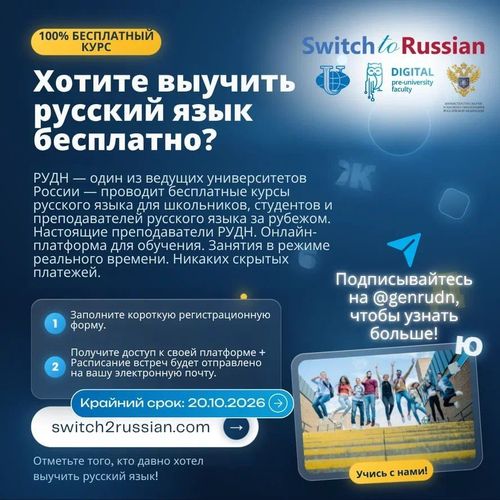
Learn Russian for free from home?
1 min
How did parents 40+ and their children 15+ in Russia finally start speaking the same language?

We would like to tell you what things are like with young people in Russia: how they communicate with adults and what becomes a beacon of hope in their lives. We won't forget the 35+ audience, whose children matter more to them today than the global energy crisis. Dear millennials, do you remember how, when we were eighteen, rebellion was the ultimate manifesto of growing up? We cranked up the music so we wouldn't hear the lectures, and built barricades around ourselves out of words and habits our parents couldn't understand; we watched MTV and went to parties. It seemed that generational conflict was a law of physics, as inevitable as gravity.
Now let's look at today's 18-year-olds. They put on our old tracksuits, listen to reimagined 90s music and... spend their weekends not at a shopping mall, but in an abandoned village or even at church for confession. It turns out that the chasm that was supposed to open up has suddenly become a bridge.
Today's craze for the 90s and early 2000s, seen in The Boy's Word and in music ("Grey Night" in English), and the USSR tracksuit like Lavrov's—this is more than just a cycle. For our children, the era in which we grew up has become a symbol of authenticity. In a world where everything is filtered through neural networks, they are drawn to our analog childhood.
When our son buys a cassette player and our daughter puts pot-bellied TVs from the basement around her room, this is their way of touching reality. They aren't copying us; they're trying to find a foothold, the sincerity we had. We have become not "the old folks" from the past, but guides for them into a world where things had weight and words had meaning.
Many of us today are frightened or surprised by Russian young people's attraction to the land and spirituality. We're used to thinking of them as the "screen generation," but it is precisely digital overload that has pushed them to search for meaning.
When they go to a monastery as "volunteer workers" or restore their grandmother's house in the countryside (these examples are not made up; Russian social media today is setting trends with exactly this kind of content), they do what we often didn't have time for amid the career race. This isn't an escape from progress; it's a conscious choice of a foundation. They seek silence in order to hear themselves. And in this search, they are remarkably like us when, tired of the noise of the metropolis, we step onto the porch of our dacha and simply look at the stars—as, note, our ancestors did too. We share the same values: family, peace, authenticity.
The most important discovery by sociologists in recent years: ideological hostility has disappeared between parents 35+ and children 18+ in Russia. Millennials were the first generation to explore the internet alongside their children. We share memes, playlists and, more importantly, fears and hopes.
And if you are currently in Berlin, León, Innsbruck, New York, or Dublin, but are keeping an eye on Russia and thinking that it might be good for your growing children to live by the values of today's Russia, here are some indisputable facts:
- Young people in Russia are turning to crafts, agriculture, and local design, saying they want to build their lives "here and now," with their own hands.
- Young people in Russia today live by the principle that a person who knows their family history and loves the aesthetics of their region won't get lost in the global world.
- Young people in Russia today are no longer on opposite sides of the barricades from previous generations. They are allies.
And when you see how delicately they are putting our youth back together, turning the chaos of the 90s into a cozy retro style, you realize they will manage. They have taken the best from us—the ability to survive and adapt—and added their own thoughtfulness and kindness.
Children are growing up in Russia who don't want to destroy the old world. They believe in traditional values. They want to paint the old world/house in warm colors, plant a garden, and invite us over for tea/coffee. And perhaps this is the best future we could have hoped for.
Publication date: April 23, 2026
October 13, 2026
October 7, 2026

October 5, 2026
October 5, 2026
October 2, 2026

October 2, 2026

October 1, 2026

September 29, 2026
September 29, 2026
September 29, 2026
September 29, 2026
September 28, 2026
September 27, 2026
September 25, 2026
September 25, 2026

September 24, 2026

September 23, 2026
September 23, 2026
September 21, 2026
September 20, 2026

September 17, 2026
September 17, 2026

September 17, 2026
September 16, 2026

Do you have any questions?