General Questions
General answers to questions about the State Program to Assist the Voluntary Resettlement to the Russian Federation
General questions
The Program is relevant to persons who meet the definition of “compatriot” (including a repatriate).
In the Russian Federation, the term “compatriot” is a legal term. Compatriots abroad include:
• citizens of the Russian Federation permanently residing outside the Russian Federation;
• persons and their descendants residing outside the territory of the Russian Federation who generally belong to peoples historically residing in the territory of the Russian Federation, as well as persons who have freely chosen a spiritual, cultural and legal connection with the Russian Federation, whose direct-line ancestors previously resided in the territory of the Russian Federation, including:
— persons who held USSR citizenship and reside in states that were part of the USSR, having acquired citizenship of those states or becoming stateless persons;
— emigrants from the Russian State, the Russian Republic, the RSFSR, the USSR and the Russian Federation who held the corresponding citizenship and became citizens of a foreign state, hold a residence permit, or became stateless persons.
A repatriate is a compatriot who has expressed a wish to participate in the State Program for the Resettlement of Compatriots, from among:
• citizens of the Russian Federation who permanently resided outside its territory as of 24 February 2022;
• persons whose renunciation of Russian Federation citizenship was duly formalized on the basis of their voluntary declaration of intent;
• persons born or permanently residing in the territory of the RSFSR who formerly held USSR citizenship;
• persons whose direct-line ancestors were born or permanently resided in the territory of the RSFSR or in territory belonging to the Russian Empire or the USSR, within the state border of the Russian Federation, and held the corresponding citizenship.
For repatriates:
• the option to choose any settlement region;
• no need to document work experience and education;
• no requirement to meet regional criteria for occupation and education;
• participation is not restricted to working age.
Repatriates link
For compatriots under the general procedure:
• a region participating in the State Resettlement Program must be selected;
• work experience and education must be documented;
• the applicant must meet the region’s requirements for occupation and education;
• participation is restricted to working age.
Compatriots link
Many regions have waived the requirement to provide documents confirming education and work experience for applicants from unfriendly countries.
As a compatriot:
A participant in the State Program is a compatriot aged 18 or older, with legal capacity, who meets the requirements established by the Program.
Family members of a State Program participant who resettle with them to the Russian Federation for permanent residence may include:
• spouse;
• children, including adopted children or children under guardianship (custody);
• children of the State Program participant’s spouse, including adopted children or children under guardianship (custody);
• the State Program participant’s parents and their spouse’s parents, including foster parents; the spouse of the State Program participant’s father (mother) and of their spouse’s father (mother);
• incapacitated or underage full siblings of the State Program participant and their spouse, as well as their underage children, including adopted children or children under guardianship (custody);
• grandparents and underage grandchildren of the State Program participant and their spouse.
An adult family member of a State Program participant has the right to participate in the Program independently.
As a repatriate:
The requirements for the participant and family composition are identical to those for compatriots (see above).
Participants in the State Program have the following rights:
• to exemption from customs duties in accordance with the law of the Eurasian Economic Union and the legislation of the Russian Federation on customs regulation;
• to receive medical care under state guarantee programs for the free provision of medical care to citizens;
• to be provided with places in social service organizations and receive other services in accordance with the legislation of the Russian Federation on social services;
• to receive employment services, including assistance in finding suitable work, career guidance, assistance with employment, paid public works, job fairs, and information about the labor market;
• to obtain a temporary residence permit outside the approved quota, a residence permit (for repatriates), and acquire Russian Federation citizenship under a simplified procedure. State Program participants may apply for admission to Russian Federation citizenship, bypassing the stages of obtaining a temporary residence permit and residence permit, provided they pass examinations in the Russian language, Russian history and the fundamentals of legislation;
• to receive education (preschool, general, secondary vocational, higher and supplementary professional).
The package of state support for program participants includes:
• reimbursement of relocation expenses to the future place of residence, including travel and transportation of personal belongings (except for repatriates);
• reimbursement from the federal budget of expenses for paying the state duty for processing documents that determine the legal status of resettlers in the territory of the Russian Federation;
• reimbursement from the federal budget of expenses for obtaining a visa under the resettlement program;
• monthly benefits from the federal budget if the person has no income from employment, business, or other activities not prohibited by the legislation of the Russian Federation, during the period before acquiring citizenship of the Russian Federation (but for no more than six months). The benefit amount is determined with regard to the subsistence minimum established in the relevant constituent entity of the Russian Federation (except for repatriates);
• a resettlement allowance from the federal budget (except for repatriates).
A constituent entity of the Russian Federation may participate in subsidizing housing expenses for participants in the State Program and provide for other guarantees and support measures in regional resettlement programs aimed at settlement and ensuring livelihoods, including social support, medical care, and assistance with employment.
Participants in the State Program and their family members resettling in territories not classified as priority settlement areas are provided with the stated state guarantees and social support, with the exception of the monthly benefit paid in the absence of income.
Reimbursements are paid by territorial bodies of the Ministry of Internal Affairs of Russia based on actual, documented expenses after the family registers at its new place of residence. The amount of payments depends on the region of settlement.
What you need to do before submitting an application to participate in the State Program:
• Review the provisions of the State Program.
Familiarize yourself with the program conditions and participant requirements.
• Choose a region of settlement.
Decide which constituent entity of the Russian Federation you plan to move to and review its requirements for resettlers.
Interview:
• If you are applying as a compatriot, you must attend an in-person interview or a video interview at a consular institution (or another authorized body).
Compatriots who are or were previously citizens of the Russian Federation, the Republic of Belarus, the Republic of Kazakhstan, the Republic of Moldova, or Ukraine, as well as repatriates, are exempt from this requirement.
Preparing documents:
Prepare a set of documents; if necessary, legalize documents issued by a foreign state by having an apostille affixed to them.
An apostille is a special stamp affixed to the original document or to a separate sheet attached to the original (in the country where the document was issued), confirming its authenticity and legality. It is required for documents issued by government authorities of a foreign state.
After preparing all the documents and making copies, the application is completed and an appointment is scheduled at a consular institution of the Russian Federation.
Before the application to participate in the SPRC is accepted, the applicant must have an in-person or video interview at the consulate (or another authorized body). This requirement does not apply to compatriots who are or were citizens of the Russian Federation, Belarus, Kazakhstan, Moldova, or Ukraine, or to repatriates.
- Wait for a response from the consular institution (the Ministry of Internal Affairs or a temporary group). The consulate sends the set of documents to the selected region (applications are usually reviewed within 60 calendar days).
- The region issues a decision authorizing participation in the SPRC or rejecting the application. If rejected, you can apply to another region.
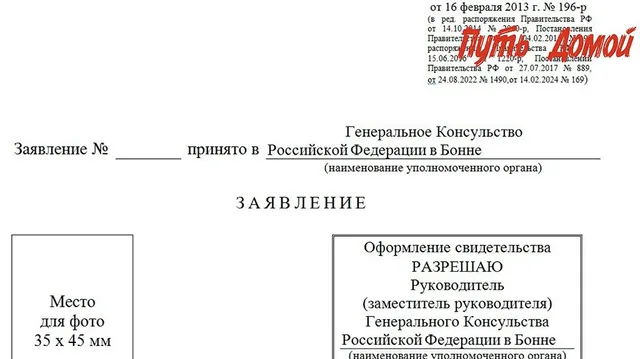
- If approved, the participant (applicant) receives an invitation from the consulate and obtains the SPRC participant certificate at an in-person meeting with a consular representative.
Participant status (or family member status) under the State Program is granted for a period of five years and confirmed by a State Program participant certificate. The certificate contains information about the participant’s family members who have been granted the corresponding status.
The certificate’s validity period cannot be extended.
It is recommended that you move to the selected region six months to one year before the certificate expires, in order to complete all necessary paperwork in the Russian Federation (obtain status in the Russian Federation, receive program reimbursements and payments, and obtain customs benefits).
If a marriage ends between spouses, one of whom is a State Program participant, the persons named in the State Program participant certificate retain their status as the participant’s family members.
If a State Program participant dies, is officially declared missing, or is declared dead, the persons named in the State Program participant certificate retain their status as family members of the program participant.
If a compatriot loses State Program participant status or voluntarily gives it up, the persons named in the State Program participant certificate retain their status as family members of the participant.
• Prepare for the move.
• Resolve property, financial, education, and transportation matters.
• Gather information about ways to transport belongings (personal effects, vehicles) and assess the risks and options.
• Wrap up affairs in the country of residence (terminate contracts, etc.).
• The possibility of applying for a temporary residence permit (TRP) in the country of residence (the TRP process can only be completed in the Russian Federation). Repatriates may also apply for a residence permit (RP) in their country of residence.
• Find housing in the region of settlement. If the region has temporary accommodation centers, coordinate the family’s admission with them.
Resettling to the region of settlement is carried out independently by the resettler family and at its own expense.
• Register with a territorial body of the Ministry of Internal Affairs of Russia as an SPRC participant (activate the participant certificate).
• In most regions, foreign nationals must register for migration purposes. The deadline for migration registration under the resettlement program is 30 + 7 working days.
• Clear personal belongings and vehicles through customs (if desired, a vehicle can be cleared later, within the temporary import period).
• Undergo a medical examination for dangerous diseases and screening for drug use, fingerprinting, and photographing.
link to medical examination
• Submit documents for a TRP or complete the TRP process (if the application was submitted abroad). Repatriates may apply directly for an RP, bypassing the TRP stage.
• Obtain a compulsory medical insurance (OMS) policy, SNILS, and taxpayer identification number (INN).
link to OMS, SNILS, INN
• Take the exam in the Russian language, Russian history, and the fundamentals of the legislation of the Russian Federation for admission to citizenship (unless exempt from the exam), if the resettler applies directly for Russian citizenship.
• Apply for resettlement allowance payments (for compatriots).
Applications for admission to citizenship of the Russian Federation under the simplified procedure are processed within 3 months.
If they wish, a program participant may submit documents for a temporary residence permit (RVP) without being subject to the quota. 8 months after receiving the RVP, they may submit documents for a residence permit (VNZh).
When submitting documents for an RVP or VNZh, the participant and their family members are exempt from taking the exam in the Russian language, Russian history, and the fundamentals of Russian Federation law.
When submitting documents for citizenship, the exam must be taken, except by certain categories of foreign nationals who are exempt from taking it.
Repatriates may submit documents for a VNZh immediately, bypassing the stage of obtaining an RVP.
State Program participants and their family members are exempt from taking the above-mentioned exams when submitting documents to obtain a temporary residence permit (RVP) or a residence permit (VNZh).
When submitting documents for Russian Federation citizenship, the exam must be taken, except by certain categories of foreign nationals.
For compatriots only!
After consulting with the Department for Work with Compatriots (Main Directorate of the Ministry of Internal Affairs), you must submit a set of documents in accordance with the established procedure.
Reimbursements are paid by the territorial bodies of the Ministry of Internal Affairs of Russia for actual, documented expenses after the family registers at its new place of residence. The amount of payments depends on the region of relocation. In some regions, part of the reimbursements is paid by the Ministry of Labor and Social Protection; please check this with your region of relocation.
For compatriots only!
After consulting with the Department for Work with Compatriots (Main Directorate of the Ministry of Internal Affairs), a set of documents for the relocation allowance must be submitted in accordance with the established procedure.
The relocation allowance is paid by the territorial bodies of the Ministry of Internal Affairs of Russia after the family registers at its new place of residence. The amount of payments depends on the region of relocation.
Assistance in resolving housing issues and finding employment depends on the policy of the constituent entity of the Russian Federation. Under a regional subprogram, a constituent entity may provide resettlers with additional support beyond the basic package of state guarantees.
This may include:
• assistance with finding employment;
• support with housing provision;
• the opportunity to receive vocational education or additional vocational education;
• accommodation in temporary accommodation centers (not available in all regions).
From the moment they obtain the relevant status, a State Program participant and their family members are entitled to:
• engage in employment as an employee;
• receive vocational education or additional vocational education;
• engage in investment and entrepreneurial activities, including without forming a legal entity and without creating new jobs;
• engage in agricultural activities and agro-industrial production;
• maintain a personal subsidiary plot;
• engage in other activities not prohibited by the legislation of the Russian Federation.
State Program participants become entitled to work from the moment their State Program participant certificate is activated.